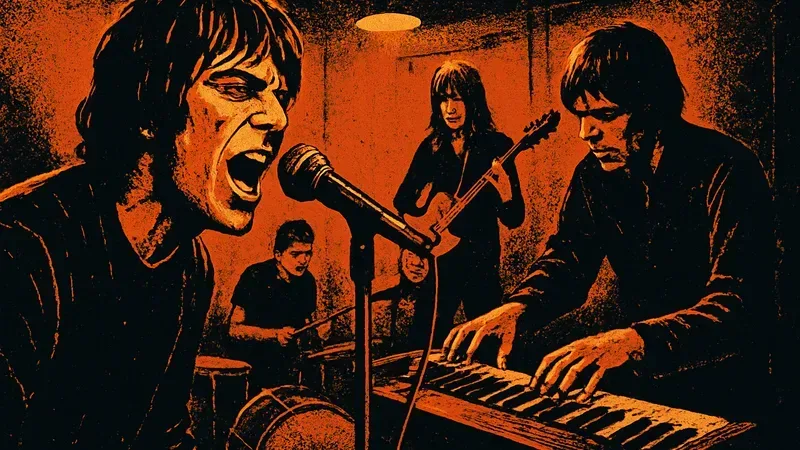
The opening guitar riff of "Pushin' Too Hard" is almost too simple. Two notes, repeated. No variation. It sounds like a band that learned the song five minutes before recording. That is exactly what makes it work.
📋 At a Glance
- Style: Psychedelic garage rock
- Years active: 1965–1968 (original run)
- Origin: Los Angeles, California
- Core lineup: Sky Saxon (vocals, bass), Jan Savage (guitar), Daryl Hooper (keyboards), Rick Andridge (drums)
- Key era: 1966–1967
- Label: GNP Crescendo
🎸 What They Were
The Seeds were a Los Angeles garage band that hit a nerve by keeping things blunt. Their sound relied on Daryl Hooper's electric piano or organ locking into a repetitive pattern while the rhythm section stayed rigid behind it. Sky Saxon sang like someone who had run out of patience. The songs rarely wandered. When they worked, they worked because nothing got in the way.
📅 History
Formed in 1965, the band released two albums in 1966—The Seeds and A Web of Sound—followed by Future in 1967. The classic lineup held through these three records. In 1968, the band renamed to Sky Saxon and the Seeds, losing Savage and Andridge. Later releases appeared sporadically into the 2000s, but the core catalogue remains the 1966–1967 material.
⚠️ The Case Against Them
The Seeds had a narrow vocabulary. Most songs follow the same template: a simple keyboard figure, a stiff beat, and Saxon's one-speed vocal delivery. The later records lose the tension that made the early work compelling. For listeners who need harmonic movement or dynamic range, there is not much here.
The repetition is not laziness. It is the point.
💡 Simplicity as Strategy
The band's best work makes a virtue out of limitation. "Pushin' Too Hard" repeats its central riff for nearly three minutes with almost no harmonic change. The tension comes from the vocal—Saxon sounds genuinely irritated, and the band never lets up. On "Can't Seem to Make You Mine," the organ line circles the same few notes while the vocal reaches for something the music will not give it.
🌀 When the Groove Shifts
A Web of Sound and Future stretch the formula. "The Wind Blows Your Hair" adds a looser, more melodic feel, with Hooper's keyboard carrying the melody while the rhythm section stays steady underneath. "Up in Her Room" runs past seven minutes, building a hypnotic mid-tempo groove that depends entirely on the locked-in keyboard and bass. The band never became virtuosos, but they understood how to hold a mood.
ℹ️The Seeds captured a specific moment when garage rock was leaning into psychedelia without losing its blunt edge. Their sound—repetition as tension—was not sophisticated, but it was distinctive.
🔥 Why They Stick
The Seeds captured a specific moment when garage rock was leaning into psychedelia without losing its blunt edge. Their sound—repetitive keyboard lines, flat drumming, unpolished vocals—was not sophisticated, but it was distinctive. Later punk and lo-fi acts would work with some of the same constraints. The best Seeds records still sound like a band that had one idea and played it until it broke.
🧩 Curiosities
- ✅ The band name came from Sky Saxon's interest in Eastern philosophy and the idea of planting musical seeds.
- ✅ "Pushin' Too Hard" was reportedly written in about twenty minutes.
- ✅ After the original run, Saxon became involved with a spiritual group and changed his name to Sunlight.
🏁 What Remains
The Seeds made three albums that matter, and those albums are built on a single idea: repetition as tension. The keyboard lines do not develop. The drums do not break. The vocal stays at the same pitch of frustration. It should be boring. It is not.
🎧 Essential Tracks
Pushin' Too Hard 1966 - The Seeds
The signature track. The two-note guitar riff and locked keyboard figure define the band's entire approach. Saxon's vocal carries the song without the music ever changing course.
Listen: Spotify · Apple Music · YouTube
Can't Seem to Make You Mine 1966 - The Seeds
The organ line circles the same few notes while the vocal strains for something unreachable. The emotional weight comes from the gap between the static arrangement and the desperate delivery.
Listen: Spotify · Apple Music · YouTube
The Wind Blows Your Hair 1967 - Future
A shift toward a more melodic, psychedelic feel. The keyboard carries the melody while the rhythm section stays steady, showing the band could stretch without losing its core.
Listen: Spotify · Apple Music · YouTube
Up in Her Room 1966 - A Web of Sound
A seven-minute track that builds a hypnotic mid-tempo groove. The entire piece depends on the locked-in keyboard and bass holding the same pattern without breaking.
Listen: Spotify · Apple Music · YouTube
A Web of Sound 1966 - A Web of Sound
The title track uses a driving keyboard line and a stiff drum pattern to create forward motion. The arrangement stays lean, letting the repetition build tension.
Listen: Spotify · Apple Music · YouTube
📚 Sources
The Seeds Wikipedia
Discography MusicBrainz
📚 Related Articles
- The Meters: The Pocket Before the Flash - Another band that built a sound on locked-in rhythm and restraint, but from New Orleans funk.
- Sleep: The Band That Made One Riff Last an Hour - If you liked the Seeds' repetition-as-tension, hear how stoner metal stretched one riff into a trance.

Comments (0)
Leave a Comment
Be the first to comment!