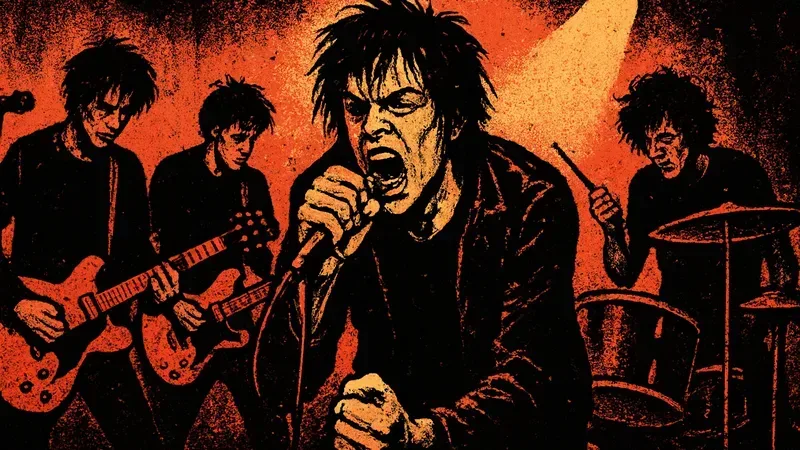
The Pretty Things didn't arrive with a plan. They arrived with a noise. In 1963, five teenagers from Sidcup, Kent, took a name from a Bo Diddley song and started playing rhythm and blues with a sloppy, aggressive edge that made their peers sound polite. The guitars stayed trebly. The drums pushed hard. The vocals—Phil May's ragged, almost snarling delivery—sounded like someone who might actually start a fight. That rawness was the point. But the band had more than one gear, and the stretch between 1965 and 1970 produced some of the most interesting rock music of the era.
📋 At a Glance
- Style: R&B, rock, psychedelic rock
- Years active: 1963–1971, 1971–1976, 1979–2020
- Origin: Sidcup, Kent, England
- Key era: 1965–1970
- Label: Fontana, Columbia, Harvest, Swan Song
🎵 What They Were
The Pretty Things started as a British R&B band, but they never stayed still. Their early singles—'Rosalyn', 'Don't Bring Me Down'—were short, loud, and built on a rhythm section that locked in tight while the guitar cut through with a thin, biting tone. By 1968, they had written S.F. Sorrow, a song cycle about a character's life from birth to disillusionment. It was ambitious, strange, and commercially ignored. They followed it with Parachute, a tighter, weirder record that earned a Grammy nomination. Then they spent decades trying to match that peak, with mixed results.
📜 History
Formed in 1963, the Pretty Things were part of the first wave of British R&B, playing covers and originals with a roughness that set them apart. They released two albums in 1965, then shifted toward psychedelia with Emotions (1967) and the landmark S.F. Sorrow (1968).
After a brief breakup in 1971, they reformed and released three more albums before splitting again. A second reunion in 1979 lasted until 2020, producing a handful of albums, including the final Bare as Bone, Bright as Blood (2020). The band's catalogue is uneven, but the best of it holds real weight.
⚖️ The Case Against Them
The Pretty Things never found a consistent audience, and the reasons are clear. Their early R&B work, while energetic, was not distinctive enough to stand out from better-known peers. After S.F. Sorrow and Parachute, the quality dropped sharply.
Albums like Freeway Madness (1973) and Cross Talk (1980) feel like a band searching for direction, with competent but forgettable songs. The later records, though occasionally interesting, rarely recaptured the tension of the late 60s.
ℹ️Despite their uneven catalogue, the Pretty Things' peak from 1965 to 1970 remains a standout period in British rock history.
🎛️ The Gap Between Raw and Refined
The Pretty Things wanted to be two things at once: a raw, blues-based rock band and an ambitious, progressive act. The tension between those impulses defines their best work. S.F. Sorrow works because the orchestration never fully smooths out the rough edges—the rhythm section still drives hard, and May's voice still sounds like he's shouting from the back of a pub.
Parachute succeeds by stripping back the ambition and letting the songs breathe. Later albums often fell into the gap between the two poles, lacking the rawness of the early years and the focus of the peak.
🥁 The Rhythm Section
The Pretty Things' early sound depended on a locked-in rhythm section. Drummer Viv Prince (and later Skip Alan) played with a steady, driving pulse that gave the guitar room to cut through. The bass lines, often simple but propulsive, kept the songs moving without clutter.
On tracks like 'Don't Bring Me Down', the rhythm section is the engine—everything else is decoration. That foundation carried into the psychedelic era, where the arrangements grew denser but the core never lost its forward motion.
🌟 Why S.F. Sorrow Still Matters
S.F. Sorrow (1968) is the album that defines the Pretty Things' legacy. It tells a linear story—birth, love, war, disillusionment—through a mix of rock, pop, and orchestral passages. The songs are connected by recurring themes, and the production, by Norman Smith, gives the record a spacious, slightly eerie quality.
It predates the Who's Tommy by a year and shares some DNA with the Kinks' Arthur, but it has a darker, more intimate feel. The album sold poorly at the time, but its influence on later concept records is hard to ignore.
🔍 Curiosities
- ✅ The band took its name from Bo Diddley's 1955 song 'Pretty Thing', a choice that signaled their R&B roots.
- ✅ Phil May's vocal style—a blend of snarl, croon, and theatricality—was often compared to Mick Jagger, but May's delivery was rawer and less polished.
- ✅ S.F. Sorrow was recorded at Abbey Road Studios while the Beatles were making The White Album, and the two bands occasionally crossed paths in the hallways.
📉 Where the Catalogue Sags
After Parachute (1970), the Pretty Things entered a long period of inconsistency. Freeway Madness (1973) and Silk Torpedo (1974) have moments but lack the focus of the earlier records.
The later albums, from Cross Talk (1980) onward, are mostly for completists. The band never again captured the combination of rawness and ambition that made their best work compelling.
⚠️Later albums often lack the rawness of the early years and the focus of the peak—listen with caution if you're not a completist.
💭 A Final Thought
The Pretty Things are not a band you need to hear everything from. But the stretch from 1965 to 1970—especially S.F. Sorrow and Parachute—contains music that rewards attention. They were never quite comfortable in any one lane, and that discomfort produced something worth remembering.
🎧 Essential Tracks
Don't Bring Me Down
A perfect example of the early sound: a locked-in rhythm section, trebly guitar, and May's ragged vocal. The song is short, direct, and built on a simple but effective riff.
Listen: Spotify · Apple Music · YouTube
Rosalyn
Another early single that shows the band's R&B roots. The guitar stays clean and cutting, while the drums push hard. The arrangement is minimal, letting the energy carry the track.
Listen: Spotify · Apple Music · YouTube
S.F. Sorrow Is Born 1968 - S.F. Sorrow
The opening track of the concept album. It introduces the orchestral elements and the narrative structure, but the rhythm section still drives the song. The contrast between the raw core and the arranged flourishes defines the album.
Listen: Spotify · Apple Music · YouTube
Parachute 1970 - Parachute
The title track from their most focused album. The arrangement is tighter than on S.F. Sorrow, with a stronger emphasis on melody and dynamics. The song shows the band at their most disciplined.
Listen: Spotify · Apple Music · YouTube
Honey I Need
A Top 20 single that captures the band's transition from pure R&B to a more pop-influenced sound. The vocal is still raw, but the chorus is hookier and the production is cleaner.
Listen: Spotify · Apple Music · YouTube
📚 Sources
The Pretty Things Wikipedia
Discography MusicBrainz
📚 Related Articles
- Big Star: The Cult Band That Changed Everything by Selling Almost Nothing - Another cult band that sold almost nothing yet influenced generations—parallel to the Pretty Things' underappreciated legacy.
- XTC: The Band That Couldn't Stop Being Interesting - Like the Pretty Things, XTC balanced raw energy with ambitious pop, never settling into one sound.
- Van der Graaf Generator: The Organ That Ate the Band - A band that also pushed prog boundaries with a unique lineup and uncompromising vision, much like S.F. Sorrow's ambition.

Comments (0)
Leave a Comment
Be the first to comment!