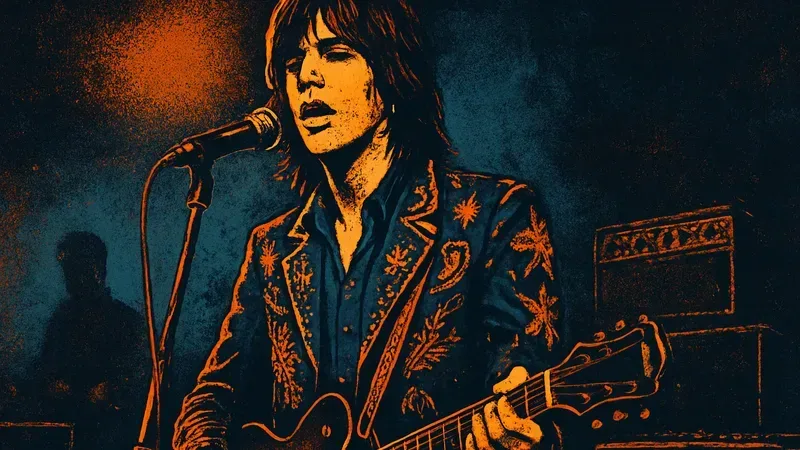
Gram Parsons sang like he was catching up to the band. His voice arrived a fraction late, riding the back of the beat, and that small delay turned every line into something unhurried and slightly bruised. It is the sound of a man who knew exactly what he wanted to say but was in no rush to say it.
📋 At a Glance
- Style: Cosmic American Music (country, soul, folk, rock)
- Years active: 1965–1973
- Origin: Winter Haven, Florida, US
- Key era: 1968–1973 (Byrds, Flying Burrito Brothers, solo)
- Label: Reprise, A&M
- Producer: Gram Parsons (with others)
🎵 Who He Was
Parsons called his music "Cosmic American Music" — a phrase that sounds pretentious until you hear what he meant. He wanted country's storytelling and pedal steel, rhythm and blues's swing, soul's ache, and rock's drive all in one room.
He never fully sold the idea to a wide audience, but the records he left behind show exactly how it could work.
📜 History
Parsons started in folk and garage bands, then formed the International Submarine Band. He joined the Byrds in 1968 and pushed them toward country on Sweetheart of the Rodeo. He left before the album was finished and co-founded the Flying Burrito Brothers, where his songwriting sharpened.
After leaving that band, he made two solo albums: GP (1973) and Grievous Angel (released posthumously in 1974). He died of a drug overdose at 26. A third collection, Sleepless Nights, came out in 1976 from session outtakes.
⚖️ The Case Against Him
His solo catalogue is tiny — two proper albums, one of them released after his death. Sleepless Nights is a cobbled-together compilation, not a finished statement. His influence is outsized compared to his commercial footprint, and some of his best-known work happened in bands where he was not the sole leader.
The Cosmic American Music concept never fully cohered on record the way he described it in interviews.
🌀 The Cult of the Unfinished
Parsons wanted to be a star but refused to make the compromises that would have gotten him there. He walked away from the Byrds at the peak of their country-rock moment. He left the Flying Burrito Brothers when they started to gain traction. His solo records were underpromoted and barely sold.
The result is a legacy built on two albums, a handful of band tracks, and a lot of what-might-have-been. That incompleteness is part of the draw. It is also the reason he never had to make a bad record.
"The result is a legacy built on two albums, a handful of band tracks, and a lot of what-might-have-been."
🎤 The Voice
The most distinctive thing about Parsons was his phrasing. He sang behind the beat, letting the melody drag against the rhythm. On "Hickory Wind," his voice sits almost alone with an acoustic guitar and pedal steel, and the delay between his syllables and the chord changes creates a feeling of distance — like he is already somewhere else.
On "Return of the Grievous Angel," he pushes harder, but the same relaxed timing keeps the song from sounding rushed. His duets with Emmylou Harris worked because their voices occupied different spaces: she sang clear and on top, he sang low and behind. The tension between the two made songs like "Love Hurts" feel both tender and worn.
🎸 The Arrangements
Parsons kept his records sparse. The Flying Burrito Brothers' "Sin City" uses a simple two-chord verse, a pedal steel line that circles the melody, and a chorus that lifts into harmony without adding instruments. On GP, the band stays out of the way — bass and drums hold the pocket, steel guitar fills the gaps, and Parsons's voice carries the weight.
He did not pile on overdubs. The space in the arrangements is what lets the lyrics land. When the harmonies arrive, they feel like a release because the song has been saving that air.
ℹ️Tip: Listen to the gaps between instruments — that's where Parsons's magic lives.
🌟 Why He Matters
Parsons did not invent country rock, but he gave it a vocabulary. His willingness to treat country music as serious art — not a novelty or a detour — changed how rock musicians thought about the genre. The Byrds' Sweetheart of the Rodeo and the Flying Burrito Brothers' The Gilded Palace of Sin became reference points for everyone from the Eagles to Uncle Tupelo.
His solo records, especially Grievous Angel, remain the purest example of what he meant by Cosmic American Music: songs that sound like they come from a place where country, soul, and rock are the same thing.
🧐 Curiosities
- Parsons coined the term "Cosmic American Music" to describe his blend of country, R&B, soul, folk, and rock.
- After his death, his manager stole his body from the airport, drove it to Joshua Tree, and cremated it in the desert. The manager later said Parsons had requested this.
- Parsons's father died by suicide when Parsons was twelve. His mother died of alcohol-related causes when he was nineteen.
💫 What Remains
Parsons made two solo albums and a handful of band records. That is not much. But the best of those songs — "Return of the Grievous Angel," "Hickory Wind," "Sin City" — sound like they were recorded in a room where everyone understood the same unspoken rules. The voice hangs back. The steel guitar answers. The song does not overstay. That is the whole thing.
🎧 Essential Tracks
Return of the Grievous Angel
1974 - Grievous Angel
The loping rhythm and pedal steel create a wide-open feel. Parsons's vocal phrasing sits behind the beat, and the chorus lifts into harmony without crowding the arrangement.
Listen: Spotify · Apple Music · YouTube
Hickory Wind
A spare acoustic ballad where Parsons's voice and the pedal steel share the same space. The unhurried delivery and simple arrangement make the loneliness of the lyric tangible.
Listen: Spotify · Apple Music · YouTube
Sin City
A dark country song with a two-chord verse and a gospel-tinged chorus. The arrangement stays lean, letting the harmonies and steel guitar carry the moral weight.
Listen: Spotify · Apple Music · YouTube
Love Hurts
1974 - Grievous Angel
A duet with Emmylou Harris. Their voices occupy different spaces — hers clear and on top, his low and behind — creating a tension that makes the song feel both tender and worn.
Listen: Spotify · Apple Music · YouTube
Streets of Baltimore
1974 - Grievous Angel
A narrative country song with a tight arrangement. The bass and drums hold a steady pulse while the steel guitar fills the gaps, and Parsons's delivery stays conversational.
Listen: Spotify · Apple Music · YouTube
📚 Sources
Gram Parsons Wikipedia
Discography MusicBrainz
📖 Related Articles
- Big Star: The Cult Band That Changed Everything by Selling Almost Nothing - Another cult artist whose small catalogue and outsized influence parallel Parsons' legacy.
- Cocteau Twins: The Voice That Wasn't a Voice - A different approach to vocal texture—where Parsons hung behind the beat, Fraser dissolved into it.

Comments (0)
Leave a Comment
Be the first to comment!