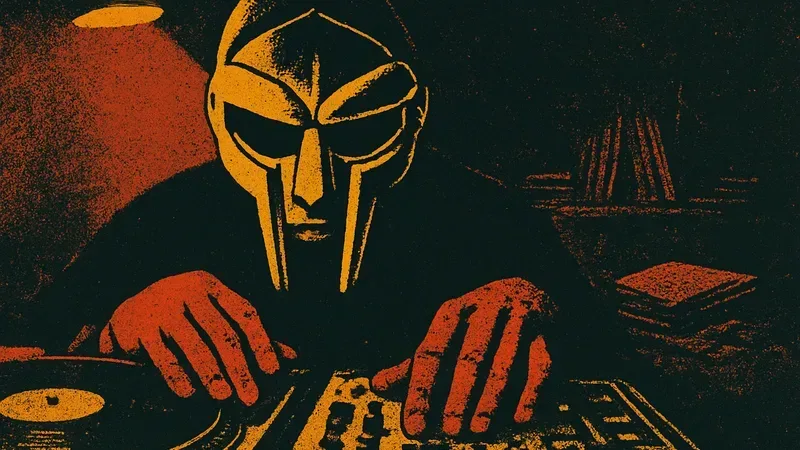
Twenty-two tracks in forty-six minutes. Most songs barely cross two minutes. Some are interludes. One is a skit about a lost notebook. This is Madvillainy, and it arrived in 2004 sounding like nothing else in hip-hop.
📊 At a Glance
- Style: Alternative hip-hop, abstract rap
- Years active: 2002–2010 (effectively)
- Origin: United States
- Core lineup: MF DOOM (vocals), Madlib (production)
- Key era: 2004
- Label: Stones Throw
🎵 The One-Album Supergroup
Madvillain was a supergroup in the truest sense: two established underground figures who met, made one masterpiece, and never quite repeated it. MF DOOM brought labyrinthine wordplay and a masked persona. Madlib brought a crate-digger's instinct for obscure samples and a willingness to let beats breathe or break. Together they made a record that felt both meticulously constructed and casually tossed off.
📜 History
Formed in 2002 after Madlib and MF DOOM connected through mutual respect and a shared label (Stones Throw). The duo recorded Madvillainy over a series of sessions in 2002–2003, with Madlib producing beats from his vast library and DOOM writing and recording verses in short bursts. The album leaked in 2003, was reworked, and finally released in March 2004. A follow-up was discussed for years but never materialized. MF DOOM died in 2020, ending any possibility of new material.
ℹ️The album's leak in 2003 led to a reworking of several tracks before the official release, a curious twist in its history.
🧐 The Case Against Them
The catalogue is one album. That brevity means Madvillain never had to sustain a career, but it also means the project feels like a brilliant fragment rather than a developed body of work. Some listeners find the short track lengths frustrating—just as a beat locks in, the song ends. The album's density can also feel claustrophobic on first listen.
⏱️ Brevity as Identity
The short songs aren't a flaw; they're the point. Madvillainy treats each track like a sketch or a punchline. Nothing overstays. The result is an album that rewards repeat listening because there's always a detail you missed—a sample you didn't catch, a rhyme you didn't parse.
But that same compression means the record never builds momentum in a traditional sense. It's a collection of moments, not a journey.
Nothing overstays. The result is an album that rewards repeat listening because there's always a detail you missed.
🎛️ Sample Architecture
Madlib's production on Madvillainy relies on obscure, often unrecognizable samples—jazz, soul, library music, spoken word—chopped into fragmented loops. The beats rarely follow standard verse-chorus structures. They shift, stutter, or drop out entirely.
On Accordion, a wheezing sample carries the entire track while DOOM's voice floats over it. On Meat Grinder, the beat is a lurching, off-kilter loop that sounds like it might fall apart at any moment.
🔤 Rhyme as Puzzle
MF DOOM's verses on Madvillainy are dense with internal rhymes, pop-culture references, and self-deprecating humor. He rarely raps in straight four-bar phrases. Instead, his lines spill over beat boundaries, pause mid-word, or double back on themselves.
Figaro is a masterclass in this: a single verse that packs more wordplay than most full-length songs. The vocal delivery is deadpan, almost offhand, which makes the complexity feel effortless.
💡Pro tip: Listen to Figaro with headphones—every syllable reveals a new layer of wordplay.
⭐ Why They Matter
Madvillainy became a template for underground hip-hop in the 2000s and beyond. Its influence shows up in the work of later artists who embraced short songs, dense samples, and abstract lyricism. But the album's real legacy is how it proved that a record could be both deeply weird and widely beloved. It didn't compromise. It didn't court radio. It simply trusted that listeners would catch up.
🔍 Curiosities
- The album leaked in 2003, leading Madlib and DOOM to rework several tracks before the official release.
Rhinestone Cowboysamples a 1970s Italian library music track, a typical Madlib deep cut.- The cover art is a parody of the cover of Madvillainy's own bootleg—a meta joke that fits the duo's sensibility.
💿 One Album, Infinite Replays
Madvillainy doesn't need a sequel. It's a closed circuit: 46 minutes of two artists at the peak of their powers, never overstaying, never repeating themselves. The album's mystery is part of its appeal. You can spend years inside it and still find new corners.
🎧 Essential Tracks
Accordion
2002 - Madvillainy
The wheezing sample defines the album's production aesthetic: a single, unusual loop carrying the entire track while DOOM's vocal floats loosely over it.
Listen: Spotify · Apple Music · YouTube
Meat Grinder
2002 - Madvillainy
The beat is deliberately off-kilter, a lurching loop that feels unstable. DOOM's verse packs internal rhymes and abrupt pauses, showing how the duo built tension through instability.
Listen: Spotify · Apple Music · YouTube
Rhinestone Cowboy
2002 - Madvillainy
The closing track uses a melancholic sample and a more relaxed delivery, offering a rare moment of breathing room after the album's density.
Listen: Spotify · Apple Music · YouTube
All Caps
2002 - Madvillainy
A rare track with a more conventional beat structure, but DOOM's vocal delivery is especially playful, with a chorus that doubles as a mission statement.
Listen: Spotify · Apple Music · YouTube
Figaro
2002 - Madvillainy
A single verse over a minimalist beat. The track demonstrates DOOM's ability to pack extraordinary word density into a short runtime without losing clarity.
Listen: Spotify · Apple Music · YouTube
📚 Sources
Madvillain Wikipedia
Discography MusicBrainz
📖 Related Articles
- Sleep: The Band That Made One Riff Last an Hour - Like Madvillainy, Sleep's single-song album proves brevity isn't the only way to make a dense, hypnotic masterpiece.
- Prefab Sprout: The Pop Band That Made Complexity Sound Easy - Another artist whose dense, layered work rewards repeated listening without ever feeling heavy-handed.
- Television: The Band That Made Punk a Conversation - A two-album cult run that, like Madvillain, turned a small catalogue into an outsized influence.

Comments (0)
Leave a Comment
Be the first to comment!