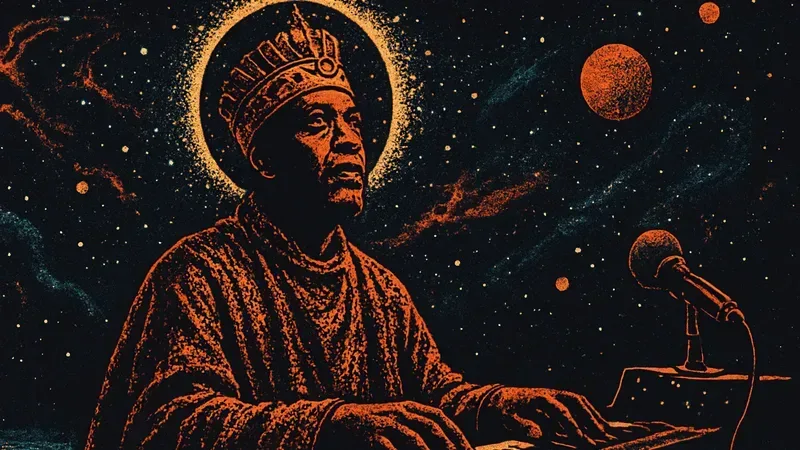
Sun Ra's music doesn't begin with a note. It begins with the idea that a band can be a spaceship, a philosophy, and a living archive of sound all at once. For sixty years, he and the Arkestra made records that sound like they were transmitted from somewhere else, even when the recording quality suggests a basement in Chicago.
📊 At a Glance
- Style: Avant-garde jazz, cosmic jazz, free improvisation
- Years active: 1930s–1993
- Origin: Birmingham, Alabama, USA
- Key era: 1965–1975
- Label: El Saturn, Impulse!, ESP-Disk
- Core lineup: Sun Ra (piano, synth), Marshall Allen (sax), John Gilmore (sax)
🎺 The Pitch
Sun Ra was a bandleader who treated the jazz tradition as raw material for a personal mythology. His Arkestra combined swing-era big band discipline with collective improvisation, electronic textures, and a stage show that treated music as ritual. The results range from sublime to impenetrable, often in the same song.
📜 History
Born Herman Poole Blount in 1914, Ra began playing professionally in the 1930s. By the 1950s he had adopted his cosmic persona and formed the Arkestra in Chicago. The group moved to New York in the 1960s, then to Philadelphia in the 1970s. Ra continued leading the Arkestra until his death in 1993. The band still performs under the direction of Marshall Allen.
ℹ️Key fact: Sun Ra's real name was Herman Poole Blount. He claimed he was born on Saturn and sent to Earth on a mission of peace through music.
⚖️ The Case Against Them
The catalogue is enormous and uneven. Some records sound like rehearsal tapes with cosmic chatter. The philosophy can overwhelm the music. For listeners who want structure, Ra's free-form passages can feel like aimless noodling. The self-published records often have terrible sound quality.
🌀 The Paradox: Controlled Chaos
Ra's music is both rigorously arranged and wildly free. The Arkestra could swing like Ellington one moment and dissolve into collective squall the next. The contradiction is deliberate: Ra treated chaos as a compositional tool, not a failure of control. The best records hold both extremes in tension.
"I treat chaos as a compositional tool, not a failure of control." — Sun Ra (paraphrased)
🎹 The Sound: Piano as Anchor
Ra's piano playing is the constant across decades. He could play stride, bebop, or abstract clusters. His synthesizer work, especially on 1970s records like Lanquidity, added drones and electronic colors that the acoustic band then played against. The piano holds the center while everything else orbits.
🎷 The Arkestra as Instrument
The Arkestra functioned like a single organism. Saxophonists Marshall Allen and John Gilmore could play unison lines with military precision, then break into individual orbits. The percussion section often included multiple drummers and dancers. Ra conducted with gestures, not sheet music.
💡Try this: Listen to how the saxophones lock into a tight unison, then suddenly diverge into free improvisation. That's the Arkestra's signature.
🌟 Why They Matter
Sun Ra proved that jazz could be a vehicle for philosophy without losing its roots in dance music. His best records—The Heliocentric Worlds, Space Is the Place, Lanquidity—remain radical because they never choose between entertainment and transcendence. The Arkestra's continued existence proves the music was never just a cult.
🔍 Curiosities
- ✅ Ra claimed he was born on Saturn and sent to Earth on a mission of peace through music.
- ✅ The Arkestra's name changed constantly; early names included the Space Trio and the Solar Arkestra.
- ✅ Ra ran his own label, El Saturn, pressing records in small batches that are now collectors' items.
🚀 Final Note: The Transmission Continues
Sun Ra's music works best when you stop trying to decode the mythology and just let the horns hit. The Arkestra is still touring. The spaceship never landed.
🎶 Essential Tracks
Rocket Number Nine Take Off for the Planet Venus (1967)
The title track shows the Arkestra at its most theatrical: a singable melody, chanting vocals, and a sudden blast of free improvisation. It's the most accessible entry point.
Listen: Spotify · Apple Music · YouTube
Space Is the Place (1973)
The theme from Ra's film. The bassline is hypnotic, the horns play in call-and-response, and the arrangement builds from sparse to dense. It's a mission statement in sound.
Listen: Spotify · Apple Music · YouTube
Lanquidity (1978)
A rare moment of smoothness. The record leans into funk and electric piano, with Ra's synthesizer providing a dreamlike backdrop. It's the most welcoming album in the catalogue.
Listen: Spotify · Apple Music · YouTube
The Heliocentric Worlds of Sun Ra, Volume 1 (1965)
The first volume of this set captures Ra's early avant-garde peak. The pieces are short, percussive, and built on collective improvisation. Essential for understanding his 1960s sound.
Listen: Spotify · Apple Music · YouTube
Purple Night (1990)
A late-career solo piano record. Stripped of the Arkestra, Ra's playing reveals its roots in stride and blues. It proves the cosmic philosophy was always grounded in technique.
Listen: Spotify · Apple Music · YouTube
📚 Sources & Related Articles
Sources
Sun Ra Wikipedia
Discography MusicBrainz
Related Articles
- Magma: The Rhythm That Built a Language - Another band that built its own mythology and language around music, with a similarly devoted following.
- Voivod: The Sci-Fi Thrash Band That Played by Its Own Rules - Like Sun Ra, Voivod used sci-fi themes to create a unique, otherworldly sound in metal.

Comments (0)
Leave a Comment
Be the first to comment!