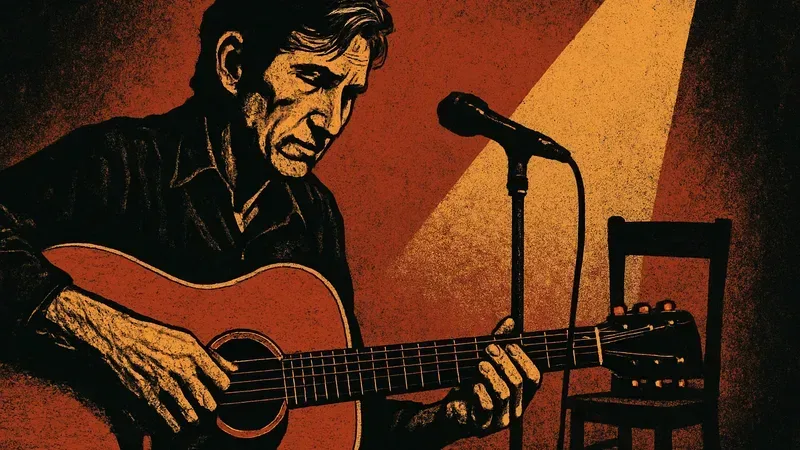
There is a moment in almost every Townes Van Zandt song where the guitar drops to a single note, the voice goes quiet, and the listener realizes they have been holding their breath. That is the trick. He made emptiness feel full.
📋 At a Glance
- Style: Folk, country, singer-songwriter
- Years active: 1968–1997
- Origin: United States
- Key era: 1968–1972
- Label: Poppy, Tomato, Sugar Hill
🎭 The Poet Who Played Guitar
Townes Van Zandt wrote songs that read like short stories set to music. His voice carried a plain, worn honesty, and his fingerpicking guitar work was precise without showing off. He never sold many records, but his songs were covered by Willie Nelson, Emmylou Harris, and Bob Dylan. If you want to understand American songwriting, you have to sit with his work.
📖 History
Van Zandt was born in 1944 and began writing songs in the mid-1960s after a troubled youth. He released his debut album For the Sake of the Song in 1968, followed by a string of records that defined his sound. By the early 1970s, he had written most of the songs he is remembered for. Later years were marked by erratic recording, health struggles, and a growing legend that outran his commercial footprint. He died in 1997.
"He was a genius. I've met very few geniuses." — Willie Nelson
⚖️ The Case Against Him
The production on his early albums can feel uneven. Some records bury his voice under string arrangements or reverb that fights the intimacy of the songs. His later catalogue is spotty, with moments where the writing loses its edge. He was also a notoriously unreliable performer, which kept him from building the audience his work deserved.
⚠️Van Zandt suffered from severe stage fright and would sometimes cancel shows or perform erratically. This unreliability, combined with uneven production, kept his commercial success far below his artistic impact.
💔 Wealth of Poverty
The contradiction at the heart of Van Zandt is this: his songs are precise, crafted, and literary, yet his life was chaotic and often self-destructive. The same man who wrote the tightly wound narrative of Pancho and Lefty could not keep his own career together. That tension between control on the page and disorder off it gives the songs their weight. You hear a man who could see clearly but could not steer straight.
🎸 The Fingerpicking Foundation
Van Zandt's guitar playing is the skeleton of his sound. He used a fingerpicking style that kept a steady bass note moving while the melody floated above. The result was a full, rhythmic sound that needed no other instruments. On songs like Our Mother the Mountain, the picking pattern drives the tension, then releases it when the verse ends. He did not play flashy solos. He played patterns that served the words.
💡Listen closely to his fingerpicking: the bass line moves underneath the vocal, creating tension that the lyrics never fully resolve. This technique is the skeleton of his sound.
🎤 The Voice as Instrument
His voice was not technically strong. It cracked, drifted, and sometimes sounded tired. That is exactly why it worked. When he sang Waitin' Round to Die, the weariness was not performed. It was lived. He did not try to smooth over the rough edges. He let the vocal sit in the same space as the guitar, with no separation. The effect was direct. You were not listening to a performance. You were overhearing someone thinking out loud.
🌟 Why He Matters
Van Zandt's influence is not measured in sales. It is measured in the songwriters who cite him as a touchstone. His approach to narrative—letting a story unfold without rushing to a chorus—changed how folk and country songwriters thought about structure. He proved that a song could be quiet, sad, and still feel complete. His best work remains a benchmark for lyrical economy. Every word earns its place.
Curiosities
- Willie Nelson once said of him: "He was a genius. I've met very few geniuses."
- Van Zandt suffered from severe stage fright and would sometimes cancel shows or perform erratically.
- His song Pancho and Lefty was rejected by several publishers before becoming his most covered work.
🕊️ One Last Verse
His best songs do not explain themselves. They sit in a minor key, let the guitar do the work, and trust the listener to catch up. That trust is rare. It is also why, decades later, people still find their way to his records. He left the door open. You just have to walk through.
🎵 Essential Tracks
Pancho and Lefty (1972 — The Late Great Townes Van Zandt)
The definitive example of his narrative economy. Four minutes that tell a complete story with no wasted words, carried by a fingerpicked pattern that never rushes.
Listen: Spotify · Apple Music · YouTube
If I Needed You (1972 — The Late Great Townes Van Zandt)
A rare love song from him, built on a simple, open chord progression. The melody is gentle, but the vocal delivery keeps it from becoming sentimental.
Listen: Spotify · Apple Music · YouTube
Waitin' Round to Die (1968 — For the Sake of the Song)
Barely two minutes long, with only voice and guitar. The arrangement leaves nowhere to hide, and the lyrics hit harder because of the emptiness around them.
Listen: Spotify · Apple Music · YouTube
To Live's to Fly (1972 — High, Low and in Between)
His philosophical side. The guitar work is more relaxed, and the chorus feels like a mantra. It shows he could write hope without losing his edge.
Listen: Spotify · Apple Music · YouTube
Our Mother the Mountain (1969 — Our Mother the Mountain)
A showcase for his fingerpicking. The bass line moves underneath the vocal, creating tension that the lyrics never fully resolve.
Listen: Spotify · Apple Music · YouTube
📚 Sources & Related Articles
Sources
Townes Van Zandt Wikipedia
Discography MusicBrainz
Related Articles
- Big Star: The Cult Band That Changed Everything by Selling Almost Nothing — Like Van Zandt, Big Star sold almost nothing yet shaped generations of musicians.
- The Blue Nile: The Sound of Deliberate Silence — Another artist who made space and restraint central to their sound, with a tiny, perfect catalogue.
- Scott Walker: The Baritone Who Left Pop Behind — A singer who also started in folk-adjacent pop and evolved into something far stranger and more literary.

Comments (0)
Leave a Comment
Be the first to comment!